Drum Team Building: How It Works and What Your Team Gets
How 10 to 500 people with no musical background build a shared rhythm in an hour: session stages, results for the team, venue requirements and answers to typical HR questions.

Drum team building is a format in which 10, 50 or 500 people build a shared rhythm from scratch in an hour or so. No musical training, no words, no winners or losers. RhythmMen have been running drum team building sessions since 2008 for companies, conferences and strategy sessions, and here we explain how it works and what the team gets out of it.
What drum team building is
Every participant gets an instrument: a djembe, a darbuka, a conga, a shaker or a percussion barrel. The drummer-host stands in front of the group and within a few minutes teaches the first simple rhythm. The group is then split into sections, each gets its own part, and the separate parts come together into one shared groove. In the finale the whole team plays a full number together with the RhythmMen performers. That is the essence of the format: the result cannot be achieved alone, it appears only when everyone listens to each other.
How a session runs: the stages
- Warm-up (5–10 minutes). Simple attention exercises: repeat the rhythm after the host, pass a beat around the circle, stop on a gesture. Participants relax.
- Base rhythm (10–15 minutes). The whole group plays one pattern. The host keeps the tempo and shows dynamics: quieter, louder, pause.
- Section work (20–30 minutes). The team is divided into 3–5 groups, by department or deliberately mixed. Each section learns its part, then the parts are layered on top of each other. This is where the feeling of «we did this together» appears.
- Solos and dialogues. Optionally, a short solo for a department or a manager, a «call and response» between sections. This is always the loudest part.
- Final performance (10 minutes). The group plays the assembled number from start to finish together with the performers. This moment often ends up in the corporate video.
Total duration is 45 minutes to 2 hours depending on the task and group size. For conferences we run a compact 30–40 minute energiser block between sessions.
What the team gets
- Communication without words. To play together you have to listen to your neighbour, not just yourself. This is trained in minutes, not weeks.
- A level playing field. The director and the intern get the same drum. Experience or title give no advantage, which quickly removes barriers.
- Introverts included. Nobody has to perform, speak or step into the centre. Everyone contributes from their seat.
- Stress release. A loud physical rhythm is an effective way to shake off the tension of a hard quarter or a long conference.
- A shared result within an hour. The team sees and hears scattered beats turn into music. This metaphor works better than any slide about synergy.
Who the format suits
We have worked with groups from 10 to 500 participants. Small teams (10–30 people) get more attention from the host and more complex parts. Medium teams (50–150) are the classic option for a corporate retreat. Large groups (200–500) are conference and forum scale: RhythmMen have run more than 500 open conferences and know how to hold a hall. The format does not depend on age, fitness or a musical ear.
How to fit team building into the programme
- Strategy session or retreat: a 1.5–2 hour session on the morning of day two; the team wakes up and tunes in to work.
- Conference: 30–40 minutes after lunch instead of a coffee break; energy returns to the room.
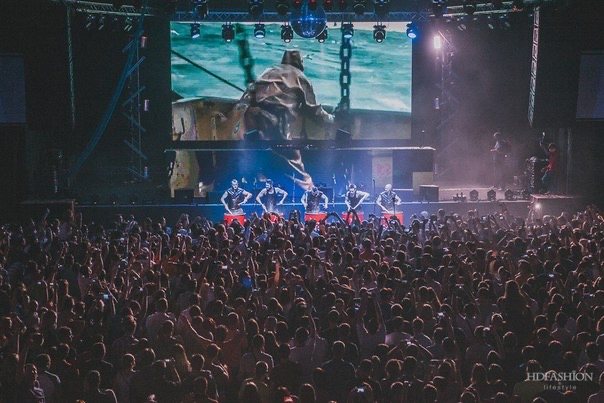
- Corporate party: a 30-minute interactive before the evening part, followed by a drum show by the performers as a contrast.
- Onboarding: a way to introduce a new cohort of employees without the awkward «tell us about yourself».
What the organiser needs to prepare
A room or site where noise is allowed: a conference hall, a gym, a marquee, a lawn. Chairs in a circle or in sectors for the number of participants. Access for loading in the instruments 60–90 minutes before the start. For large groups, a microphone for the host. We bring an instrument for every participant; nothing to buy or rent. Technical details are collected in the drum show rider, and what shapes the budget is explained in how much a drum show costs.
Frequent HR questions
Do people need a musical ear? No. Rhythm is a basic human skill, and the host adapts the parts to the level of the group.
What about those who «do not want to»? Usually they are playing within 10 minutes. If not, they join the rhythm section on shakers, where the load is minimal.
Can it carry a corporate message? Yes: the project name as a rhythmic phrase, company colours in the final number, departments as sections.
Summary
Drum team building gives a team something that is hard to get from a training course: a shared result you can hear, and an experience people talk about for years. Look at photos from our sessions in the gallery and tell us about your team; we will choose a format for the number of participants and the task. More about the service on the drum team building page.
Book a performance
Leave your contacts — we will call you back, clarify the event format and send a proposal.